Nest
Key takeaways
- List every recurring bill once, with its due date, how often it comes round and its usual amount.
- Get a reminder on the due day, and mark each bill paid so nothing is paid twice or missed.
- Make bills visible to everyone in the household, so the job is shared and not assumed.
- Look ahead monthly, and set aside money for annual bills before they arrive.
A household bill tracker is a simple list of the payments you must make regularly, with when each is due and whether it has been paid. It does not need to be fancy. It needs to be complete and visible to the people who pay.
Step 1: List every recurring bill
Go through your last two or three months of statements and write down every payment that repeats. Do not forget the ones that renew quietly.
| Bill | How often | Notes |
|---|---|---|
| Rent or mortgage | Monthly | Fixed amount and date |
| Utilities (power, water, gas) | Monthly | Amount changes with the season |
| Internet and phone | Monthly | Usually fixed |
| Insurance (home, car, health) | Monthly or yearly | Check the renewal date |
| Loans and credit cards | Monthly | Minimum due date matters most |
| Subscriptions | Monthly or yearly | Easy to forget, easy to cancel |
Step 2: Record the due date, how often and the amount
For each bill, note the due date, how often it comes round and the usual amount. Amounts that change, such as utilities, can be an estimate. The date is what matters most, because a late payment costs more than a slightly wrong estimate.
Step 3: Get a reminder on the day
A list you have to remember to open does not help. Use something that tells you when a bill is due, ideally every person who might pay it, so it does not depend on one reminder on one phone.
Step 4: Mark each bill paid
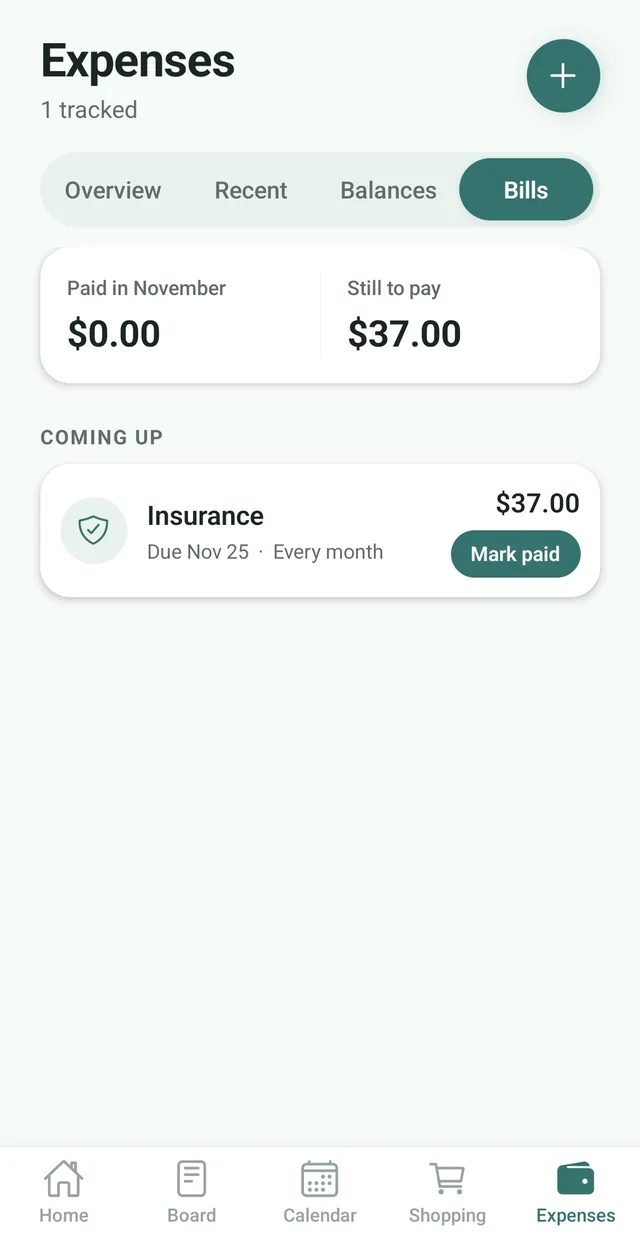
When you pay a bill, mark it paid straight away. It stops a second person paying it again, and it shows at a glance what is paid this month and what is still to pay. For repeating bills, the next due date should roll forward automatically.
Step 5: Decide who pays, and who splits what
In a shared home, agree on who pays each bill and whether the cost is split. Couples, roommates and families all benefit from the same rule: the payer records it, and the split is visible to everyone. See our guide to splitting household expenses for fair ways to divide the costs.
Step 6: Plan for the bills that come once a year
Insurance renewals, registrations and annual subscriptions land in a single month and can sting. Divide the yearly amount by twelve and set that aside each month, so the bill arrives on money that is already there.
The bottom line
Missed bills usually come from invisible due dates. List every bill, record when it is due and how often, get a reminder on the day, mark it paid, and make the whole thing visible to everyone who pays. Then look ahead once a month.
Frequently asked questions
How do I keep track of household bills?
List every recurring bill with its due date, how often it repeats and its usual amount. Get a reminder on the due day, mark each bill paid when you pay it, and keep the list somewhere everyone who pays can see it.
What bills should I track?
Track anything that repeats: rent or mortgage, utilities, internet and phone, insurance, loan and credit card payments and subscriptions. Add annual bills too, such as insurance renewals.
How can I avoid paying bills late?
Make the due date visible and get a reminder on the day. Marking a bill paid as soon as you pay it also prevents double payments and missed ones.
Does Nest have a bill tracker?
Yes. The Bills tab in Nest Expenses tracks each bill with its due date and how often it repeats, reminds the family at 9 am on the day it is due, and lets you tap Mark paid. Bills come with Nest Premium.
How do I share bills with a partner or roommates?
Agree who pays each bill and how it is split, record it where everyone can see, and settle up regularly. In Nest you can split a payment with the family or record it as your own.