Nest
Key takeaways
- Start by tracking one full month of real spending, not by guessing.
- Use a dozen categories or fewer, so the budget stays easy to keep up.
- Set a monthly limit for each category from your real numbers, and keep fixed bills separate from flexible spending.
- Check in before a category runs out, then review together every month.
A family budget is a plan for the money coming in and going out each month, shared by the people who spend it. The goal is not to spend less for the sake of it. It is to decide ahead of time where the money should go, so there are fewer surprises and fewer arguments.
This guide is general information, not financial advice. Your own situation, income and goals will shape the numbers.
Step 1: Track one full month of spending
Before you set any limits, find out what you actually spend. Record every expense for a month, big and small, from rent to coffee. Most families are surprised by two or three categories, usually groceries, eating out or small recurring subscriptions.
Use one shared place to record it, so nobody has to chase receipts at the end of the month. Our guide to tracking family spending covers a simple weekly habit.
Step 2: Group spending into categories
Categories turn a long list of purchases into a picture. Keep them broad. Too many categories make a budget tiring to maintain, and too few hide what is going on. A dozen is plenty:
- Groceries
- Rent or mortgage
- Bills and utilities
- Transport
- Eating out
- Kids
- Health
- Insurance
- Entertainment
- Shopping
- Travel
- Other
Step 3: Separate fixed bills from flexible spending
Some costs are the same every month and cannot easily change. Others move with your choices. Treating them differently makes the budget much easier to set.
| Type | Examples | How to budget it |
|---|---|---|
| Fixed | Rent or mortgage, insurance, phone and internet, loan payments | Use the exact amount and the due date |
| Variable | Utilities, fuel, groceries | Use the average of your last few months |
| Flexible | Eating out, entertainment, shopping, travel | Set a limit you can live with, and adjust it as you learn |
Step 4: Set a monthly limit for each category
Start with last month’s real spending, then adjust. Fixed bills come first. What is left is what you have to share between the variable and flexible categories. If the numbers do not add up, the flexible categories are usually where the family can choose what to trade off, together.
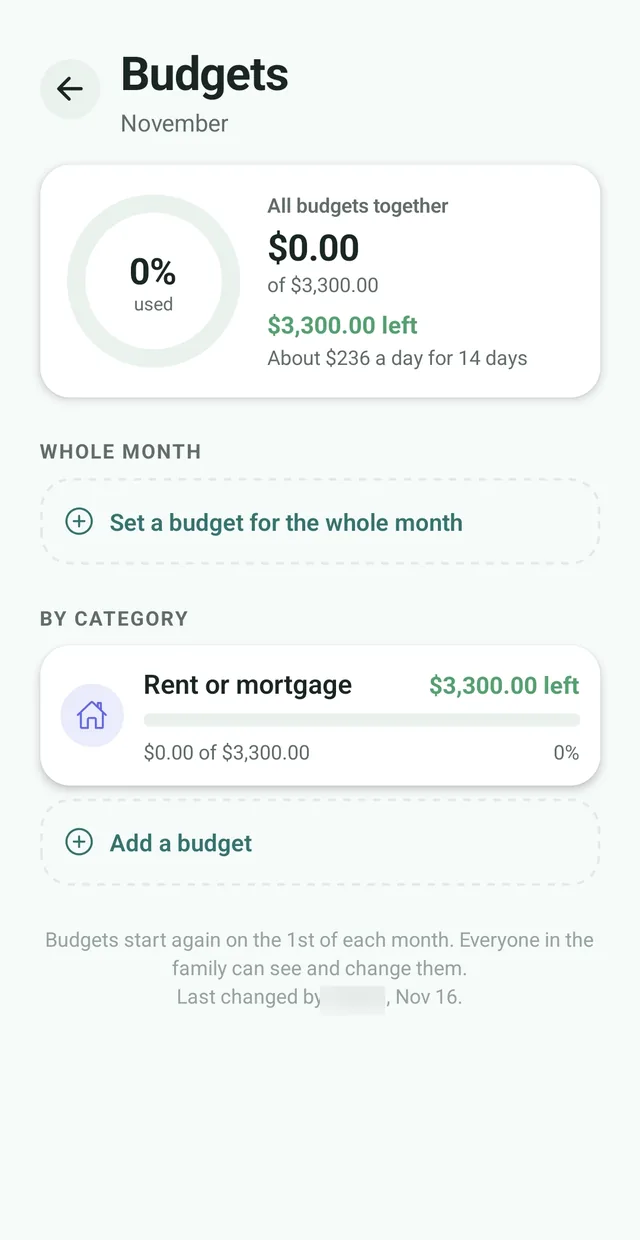
Some families also set one limit for the whole month as a safety net, on top of the category limits. Some use a rule of thumb, such as splitting income into needs, wants and savings. Use whatever you will actually keep doing.
Step 5: Check in before a category runs out
A budget that you only look at on the last day of the month is a report, not a plan. Look at it partway through, and pay attention to the point where a category is about 80% used, because that is when you can still change course. If groceries are at 80% with ten days left, you have time to plan simpler meals.
Step 6: Review together every month
Once a month, spend fifteen minutes going over where the money went, what surprised you and what to change next month. Do it together, with the same numbers in front of everyone. A shared view turns money talks from “who spent what?” into “what do we want to do next month?”
- Compare this month with last month, category by category.
- Look at the categories that went over, and ask why.
- Move limits to match reality, up or down.
- Agree on one thing to change next month.
Common family budget mistakes
- Setting limits from hopes, not numbers. Base them on what you really spent.
- Forgetting irregular costs. Car repairs, gifts and annual bills need a place in the plan.
- Making one person the budget keeper. A budget only one person can see rarely survives.
- Giving up after one bad month. Adjust the limit and carry on.
The bottom line
A family budget is a few honest numbers and a monthly conversation. Track a month, group the spending, set limits, look partway through and review together. Keep it simple enough that everyone in the family can see it and use it.
Frequently asked questions
How do I make a family budget?
Track a full month of spending, group it into a few categories, separate fixed bills from flexible spending, set a monthly limit for each category, check in before a category runs out and review together every month.
What categories should a family budget have?
Most families do well with about a dozen: groceries, rent or mortgage, bills and utilities, transport, eating out, kids, health, insurance, entertainment, shopping, travel and other.
How often should a family review the budget?
Once a month is enough for most families, with a quick look partway through the month. A review takes about fifteen minutes when everyone can see the same numbers.
How do couples budget together?
Agree on shared categories and limits, keep everything in one place both of you can see, and review together each month. Some couples also keep a small amount of personal spending outside the shared budget.
Is there a family budget app?
Yes. Nest: Family Organizer lets a family set monthly budgets by category or for the whole month, shows what is left and tells everyone when a budget reaches 80%. Budgets come with Nest Premium, and expense tracking is free.